
Measuring performance in running is very different to most other sports.
It is totally up to you.
Sure, you can be part of a team that qualifies for other races. You can compete against other people to chase medals or records. Other runners can inspire you to run better than you would have without their support.
Even considering this, at the end of the day, only you, and the space between your ears can decide just how fast you run.
All those accumulated hours of pain, mental battles against our inner demons, blisters so bad it hurts to walk, are only made worthwhile when we reach our potential.
This could be many things:
- Completing a 5k in under 30 minutes
- Achieving a Boston qualifier
- Hitting the Olympic trials standard
- Running a time fast enough to where your country will finally consider you good enough to represent them…..
Other than a few Olympians who dream of, and win an Olympic Gold, the goals for runners all have one thing in common; that moment when you cross the finish line, must be under a particular number on that clock, or it is back to the drawing board.
Try again.
The higher up you go, the more you are restricted by time.
When I was in college, my primary goal at the beginning of each season would be to hit the automatic national qualifying time as early as possible. I did not have to worry about it for the rest of the year; I had booked my ticket to nationals.
It was hard to shake that focus on time when I left college, especially as so many of the next level rewards I worked for were determined by time.
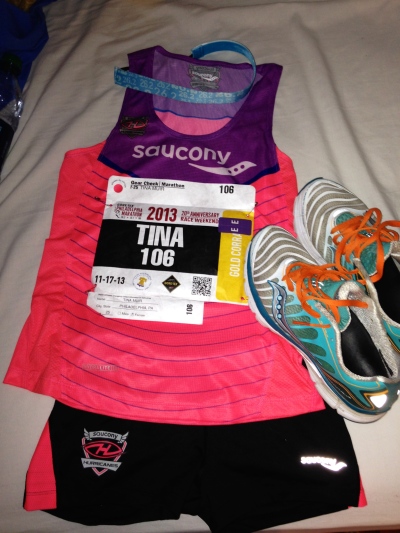
My Saucony sponsorship, complementary entry to races, sampling products.
All required fast enough PRs to be considered worthy of reward.
Thankfully, my times were fast enough, but I started to become obsessed with time goals.
Expecting more and more out of my body, giving it less and less credit as I continued to run faster and faster….until seconds off a PR were not enough, I wanted minutes!
Even though I forced myself not to look during, I would feel irritated after my easy runs if my average pace was 7:50 instead of the 7:30 I deemed acceptable.
Long runs were even worse, I would watch my Garmin, obsess over the average pace creeping down.
I definitely became carried away with those; no one at my level should be running 6:12 average for 20 miles, 5 weeks before their marathon.
All I could think about, talk about, obsess about, was running that sub 2:40 marathon. It didn’t even cross my mind that I wouldn’t do it. In my mind I already had done it.
Steve continued to plead with me not to obsess over a time, which I replied with “yeah, I know”, but realistically it went in one ear, and out the other.
How dare he say I might not hit a time?
After all, in college, whenever I set a time goal, I reached it.
Every. Single. Time.
However, my debut marathon did not play out how I expected, and I did not reach that time goal.
Not even close.
I brushed it off as fueling mistake, and for the most part, it was, but I began training for Chicago still having that 2:3? overtaking my mind.
Many disagreements later, during my meltdown run, Steve finally got me to listen, and understand that with a marathon you cannot set a time goal.
Slowly, during this marathon segment, I have realized that with marathon training there really are no guarantees.
All you can do is perform the best you can on that day, with what your body gives you.
There are too many factors that can go wrong from day to day that can affect any run, workout, or race. Which is why I now recommend runners use the effort scale for racing, to just focus on doing the best you can.
Any combination of these factors could easily affect the time it takes to complete any one run:
- Temperature
- Humidity
- Yesterday’s run
- The day before yesterdays run
- Last weeks mileage
- Your accumulated sleep this week
- What you ate the night before
- What you ate the morning of
- Hydration
- Your emotions
- The wind
- How long you were sitting before you ran
- Many, many more
For that reason, as you struggle your way through the grind of marathon training, you should stop thinking, or obsessing about what you HAVE to do.
We should NOT set time goals for race day.
You need to let go of a specific time that you feel justifies what you “deserve” and just run.
In running there is no guarantee. You could be the fittest you have ever been in your life, and it could all go wrong. Bad weather could mean it is literally impossible for you to run that time you want to run.
You will get what you deserve, but just not when you command it to.
Put one foot in front of the other, and run.
As long as you cross that finish line feeling as though you gave it your all, that’s all you can ask for.
The result will take care of itself, and your body will do its absolute best with the circumstances on the day.
My thinking for this has been rewarded as I have felt a sense of calm in my running, and I ended up smashing that 2:40 I was trying to beat, and running a 2:36 in the California International Marathon…once I let go of that time goal.
Most people run their best when they are not concerned with a particular pace, but are just running, just doing what their best judgement/gut feelings tell them to do. And that is why I decided to created to Mile 20 Mental Training Course, it has ALL sorts of modules from distractions, finding your why, journaling, visualization, etc.
I am asking you to take the pledge with me, and see how much better you do when you take the pressure off, and just run.
That is the beauty of our sport; its simplicity, lets keep it that way.
Goal Setting Guide for Runners
Not sure how to set realistic goals for you?
This worksheet will help you find out



44 Comments.
From your list of factors which may affect your goal, you forgot to add hormones! lol. Just don't forget how my hormones suddenly became a factor (combined with the weather and my dizzy issue) in the Fitness Magazine half last spring. It's so not fair that men don't have to worry about the hormonal affect but it is real and can't be controlled. I like your new approach, you are taking some of the pressure off which I bet will only help you to reach your time goal.
Really, the best thing you can do is just do your best and not anticipate anything and pressure yourself to do sinethibg. I've learned that and im trying to honour that.
I'm proud of you Tina, you are already good enough!
I actually right on with you in not setting a time goal for this marathon. In fact, I haven't even run with a garmin for the past 3 long runs, and I haven't been running with it during the week. If it is in front of me, I will just sit there and think about the numbers. But also? I just want to get out there and love the run. I have the speed (though, sure, I could have worked harder), so we're just going to have to see if my training has paid off. Like we always say, TRUST YOUR TRAINING.
I think this is really courageous and fantastic. I know you will do great at the race, but I also know how terrible it is to get trapped in the numbers game! It's hard to get out of but yesterday I ran a tempo run, and I don't have a garmin so getting to my phone is hard, but I just ran it. I ran it with more effort but still felt good, and it ended up being around 7:30ish for the tempo duration. I was so excited about it, and it was nice that I wasn't trying to get there, but just ran by feel. It's amazing what our bodies can do!
Tina, this is an AWESOME and INCREDIBLE post. Your honesty is so raw and real, I think that people often associate obsession over numbers only with calories consumed, BUT gadgets like the Garmin or Polar Watch fuel an obsession with performance numbers. I totally understand where you're coming from, I used to wear my Polar RELIGIOUSLY, pushing myself to burn x amount of calories. Calories burned = how good of a workout I had, but realistically you burn more doing cardio than lifting at the given moment. I ended up DITCHING my polar watch this year and haven't been happier since, I know it's not the SAME situation as you, but it's similar. I think you'll do AMAZING in your race because there won't be as much pressure <3 xoxo
My husband started running this year and earlier in the year he was getting faster and faster. Then summer hit and the extreme heat and humdity obviously slowed him down. He was getting frustrated at first until he accepted that there are SO many different factors that can affect your time! You have to just roll with the punches and give it your best!
I almost always race without a GPS, or like my last race I wear it but do not look at it. Your comment about only being able to do what your body & mind are capable of is spot on. Seeing I'm ahead of pace won't make me run faster, but if I'm suffering and behind pace won't give me any extra motivation either!
Even for the majority of my training, I generally just go by time and when I log my miles for the week I have a rough idea of the pace and plug that distance in. My body does not care if I logged the correct hundredth of a mile into the book 😉
I actually stopped setting goals other than being within a range and oddly enough, I blew my old PR out of the water doing that. I completely shocked myself because I all I wanted was to stick to 1:50 for my half. Race day I just went with it, had a great day and ended up with 1:38. Had I set that as my goal though? I'm pretty sure I would have figured out a way to flub it b/c I would have been obsessing over it. It's so easy to get caught up in always hitting a certain pace. I've really tried to stop that lately especially as I'm transitioning into new territory … my first full.
what a coincidence…I am not an elite athlete (or even a good amateur one) but have recently got out of my running groove, so last night I just decided to go for a 45min run, paying no attention to my pace and just trying to relax and enjoy it. I ended up running 7km, so it was not speedy, but I did enjoy it and am l raring to go again tomorrow 🙂
you could also add badly calibrated nike+ to your list of variables! I was so sure I'd been training well and was really pleased with my pace for my last HM, so was utterly devastated to round the last corner and spot the time on the gantry…a quick bit of mental arithmetic told me I was already outside my <2h target. After the race I checked my Nike+ and it said I'd run >23km…only myself to blame for not checking the calibration more regularly!!!
I love the crap out of this post. Last summer I was training hard trying to get into PR shape after taking some time off for an injury and I got really burned out mentally from not hitting my paces I wanted (it was hot because it was in the summer, duh, Beth), so I took a break and really had to step back and stop focusing on enjoying my runs. I'm still doing most of my runs at an easy effort to make sure I'm fully enjoying my runs and my goal for my next few races is just to finish. I'll probably start to throw in a little speed work soon, but I don't want to have my pace dictate whether I had a good run or not. Thank you so much for continuing to write inspiring blog posts!! <3
I can really relate to this post. Couldn't have said it better myself.
I've been dying to break the 3:30 mark in the marathon, and had pegged Boston this past year as the place where I was going to do it. I trained harder than ever and have run a 3:32 and thought I had it in the bag. But then it was hot on race day (after running in negative temps and snow all winter), no cloud coverage, I started later than expected, and all in all I ended up with a 3:38, and it was not easy. Felt 100x harder than my 3:32.
Sometimes, it's just not the day for a specific time or PR in the marathon and I'm working on getting more used to that and accepting it. Keeping 3:30 in the back of my mind, but no feeling disappointed after finishing a marathon!
and all you can do is show up on race day and do you're best. We know that all too welll friend. xxoo
Tina, this is one of my favourite posts to date. I am a deeply stubborn goal-oriented person, and while it worked to an extent with school, work, and other areas of my life, I've been SLOWLY realizing that I have to let go of these things when it comes to running. This has been the first year where I've been finally listening to the same advice – I used to join a running group with a specific goal in mind that I'd ask to have a program designed to get me there. This year, I went in with the right intentions – saying I just wanted to get faster and seeing how things went. But I continued having “secret” goals and I'd always be disappointed when I wouldn't reach them. I'm trying really hard to come to the same realization that you have for my upcoming Fall races, and this blog post pushed me a little closer to that direction. Thank you for your honesty and inspiring words. I can almost feel a sense a peace over you in your latest blog posts, so I do believe that you're taking Steve's advice to heart and really listening to it. I will be cheering so hard for you over here in Toronto next month! xo
For you Tina I will do it this weekend! I am doing an event called the Aching Quad- 4 races in 24 hours. 2 5k, 1 mile & 2 mile- easy in your world- big deal in my world! I am going to have run and say I got it done! I will not will not stare at my Garmin- I am just gonna run! Enjoy the weekend!
Tina I cannot tell you how much I needed to read this post! I have been carrying way too much self-inflicted pressure into each and every run of this training cycle because I'm chasing a number. Honestly, it's been taking the joy out of running for me. So I am with you on this! Yes I really want a PR in Philly but I will now try to take what my body gives me on each run and let go of the rest. Thanks for continuing to inspire me Tina!
Thank you for this post! I need to write this down on a sticky note –> “That is the beauty of our sport; its simplicity, lets keep it that way.” So much truth to that.
I am in the last two weeks of training for a half and my person goal is to run sub-1:30. Easy for some, but that is chopping off 4 minutes for me! Like you said, there are so many variables that affect our running time.
I have been reading Ryan Hall's book “Running with Joy” (one of my favorite books!) and he makes a good point of not letting our performance determine our joy. No matter how the upcoming race goes, I want to have joy, be thankful that God has blessed me with the health to run, and just be okay with the time I run!
Amy @ http://www.livinglifetruth.com/
Great post-I tweeted you but I definitely need this. I have major marathon jitters for Chicago and am anxious that I won't reach my time goal and that I'm undertrained etc. This “All you can do is perform the best you can on that day, with what your body gives you. ” reminds me of how much of a beast the marathon is. Some days, it just isn't your day and your body wakes up deciding something weird, no matter how many great long runs you had. Cheers!
I heard this quote and it made total sense – you will never meet your level of expectation but you will always default to your level of training.
It's definitely hard not to get wrapped up in a time goal, I have struggled with that many times. I think you have a good mindset heading into Chicago next month and that will pay off huge. I have to constantly remind myself the next 9 days- that no matter what I just need to control what I can and adjust to what I can't… and the time will follow.
Yep – definitely needed to read this. I'm such a goal oriented person but at the end of the day I have to ask WTH does it matter if I meet some 'goal time'. I should run. Enjoy it. Be injury free. End of story.
Great post! It's really hard not to set a time goal for any race. There's always things you can't control so it's nice to start out with the intention of doing your personal best for that day.
Good luck in Chicago!
I have no doubt you will DESTROY that Philly time…no doubt at all. Wishing you all the best and I will be tracking you Chicago race morning. Go Tina!!
You've given me so much to think about for my Nov race! Wise words my friend.
Beautiful post!! You seem to have such a good mindset on this. Lately for cross country I've been focusing more on beating my times from last year. Not hitting a certain time or getting a certain place but just getting better myself! Good luck at Chicago – you're gonna kill it!!
I cannot tell you how much I love this post and how spot on it is. As I ramp up for Chicago too, I've been thinking much the same way. I really want to qualify for Boston, and I have this time goal in my head. I know I am very qualified to hit the time, but some of my recent long runs tell me that might not happen. I am trying to let go of numbers too and just run. I do my best when I just run and my goal is to enjoy the race, enjoy the miles and FEEL GOOD. I hope I'll get to meet you in Chicago. Good luck with the next 4 weeks. You are an inspiration and a rock star.
love this post! The other day I went for a run for the first time in a long time and I didn't keep track of the time. It was awesome!
Oh – I so wish I had read this earlier this week. I agree – setting specific goals prior to the event doesn't take all of the race day factors into account.
I do sometimes suffer from time obsession but that is because I know I can go faster if surrounded by the right company. My running buddies push me and sometimes we like to use that run time as catch up time so we aren't going all out because we are trying to talk. I do plan to sign up for the next 5K and I want to do it under 30 minutes but w/ the crowd expected, not sure I will. Either way it is all good – I am willing and able because I have use of my legs and faculties so I will just do my best and enjoy the scenery. Great post as always.
great post — i'm going to carry this into my race tomorrow 🙂
I totally get it. I had to stop working out with a heart rate monitor and lay low on the pedometer because I was become a slave for numbers. And I didn't even had a reason as good as yours! Good for you for knowing when to take a step back.
Oh girl you are so brave! Seriously. Last Saturday I had a 4 mile-race and decided to not look at my Garmin at all simply because it was 85 percent humid and over 75 degrees, so I knew going by feeling was the only option. However, the Marathon is another beast. I currently don't have an actual time goal for NYCM just because, since I strained my hip flexor a month ago, my training has been getting worse and worse. I still do my tempo runs at my original goal MP, but it feels harder that it should, so I know that time is probably too ambitious. That said, I know that, comes tapering, I will have to make a decision and pick a time goal to stick to. For shorter races, I can go without a time goal and just see what my body is willing to give me on that day. But for the Marathon, I need to have a plan. Which makes me want to ask you: how do you plan to pace yourself during Chicago? I feel 26.2 miles would be too long for me to just go by feeling… Knowing myself, I'd either fly and die or, like last year, start way too slow. All that said: do whatever is best for you cause I know in my heart that, whatever strategy you'll decide to use, you'll do great and kill that Marathon!
I set goals but based on recent training rather than external standards. I like what Lauren Fleshman recently posted about having a range of goals: A=an ok day, B=a good time, you may or may not make it and C= a stretch goal that would rock your world if you made it. Takes some pressure off and lets you adjust expectations during the race.
What a refreshing and honest viewpoint from an elite runner! Thank you for sharing your plans for Chicago. It's true that so many things can affect race day performance and if you have your eye on a specific number it can all go to pieces really quickly. My goal for Chicago is to run smart and finish strong. I have a range where I want to finish (time wise) but my focus is on how I am feeling that day.
We have an data obsession, to the point of “paralysis by analysis”.
Some of the best runs I have ever had were ones were I didn't care about the outcome. I just wanted to go out there and enjoy it, and enjoy I did, and was also surprised at how freeing it is to let go of the stats, and data and so on.
I know my goals have shift away from time and more to experience, which is why I'm doing trail runs more than road.
Oh yes! I am definitely a bit obsessed with the numbers, but on the same token, the numbers motivate me to run. Of course, I'm a casual runner, a displaced gym rat if you will, so any motivation for me to just put on the shoes is a good thing. I can see how I'd need to put down the watch for a while though if I were more into running and could be more easily motivated just for the love of the sport. Good luck with training!!!
I think anyone who races gets sucked into the time crunch and *must get faster* feeling, so I'm not surprised as an elite it's so easy to let the numbers run your life and dictate your happiness.
I hope it all comes together for you at Chicago next month, and I'll most surely be rooting for you 🙂
I let go of my PR goal for a half marathon a few weeks ago after I burned myself out earlier this summer. I started a training plan dead-set on hitting specific numbers for all of my runs, but about halfway through, realized it just wasn't going to happen. My body needed a break. It made my training so much more enjoyable to not stress over whether my workout was an A+ or an F. Today was race day, and I managed to get a PR, and I think a huge part of it was not having the stress of a time goal weighing me down.
Great post Tina! It's so easy to get caught up in a goal that you stop enjoying what you are doing. Races are supposed to make us feel good about our accomplishments and pushing our bodies not disappointed that it took us extra seconds to do so. I can only imagine how hard that must for you to do at your level but I applaud your effort and I love your honesty.
Great post! I'm sure the pressure elite runners have is HUGE and on top, you have to make your sponsors happy. You are brave for NOT setting a time goal. I have a feeling you will do AWESOME in Chicago though!!
you had me with the title of this post. LOVE it!!!! and yes, i have totally been data obsessed, and now have a healthy-ish relationship with it. lol.
i keep saying i won't run anything for time, but of course this doesn't always play out. and i'm no pro just the exhilaration of being out there gets me all giddy and well, going faster? my best runs have definitely been unplanned per say, like yesterday. just wanted to do a run to see if my right leg was ok but all the cyclists on the road threw my mind off and i just started running to dodge them, and 9 miles done i had surprised myself. no complaints 🙂
wow I love love this post. I always push really hard for my goals and am planning to run a marathon this year but everything you're saying is spot on! Great post!
Wow Tina I'm always really impressed with your running performance but now I'm even more impressed with your mental performance! I LOVE this post and you are going to rock Chicago in every way! #wowlinkup
Since I don't run anymore it is not important to me. I will send you an email so I will tell you what I will be wearing. #wowlinkup
Welllll… my next race is a marathon so I can't promise no goal, since my goal is to cross. Secondary goal is to run in the low 4s. But crossing the finish line will be enough.
Actually, JK. Running a work 5K Thursday. I'll do that with no goal 🙂
I read this post last year and I’m re-reading it again before I run my next marathon this Saturday. Your advice is so wise! I have trained with a specific finish time range in mind, for the sake of training paces, but now I’m doing my best to not have huge expectations on race day.
My race “goal” is to do this —> “Put one foot in front of the other, and run. As long as I cross that finish line feeling as though I gave it my all, that’s all I can ask for. The result will take care of itself, and my body will do its absolute best with the circumstances on the day.” Thank you for sharing this, Tina!