A lot of you have requested to hear more about what my strength coach Drew and I get up to in our workouts. I see Drew twice a week for a one hour training session, but he has become so much more than a coach to me. A friend I can count on, and someone I have enjoyed getting to know.
I thought you would enjoy reading his perspective of our training, and some examples of what we do for you to maybe add into your training. Without his coaching, and without him making me stronger, I would never have run a 2:41 in the London Marathon, 1:13 half marathon, or won the Army 10 mile, so I am so thankful.
So, without further ado, here is what it is like to be the strength coach of Tina Muir.
Welcome Drew!
Things to know:
- Runners tend to be driven individuals (i.e. a little crazy) *Editors note- us? Never!*
- Runners tend to be very hard on themselves *okay, that is true*
- Runners tend to do too much – see bullets 1 & 2 *guilty!*
- Mastering a handful of basic strength exercises will benefit most runners tremendously *100000% agree!*
When Tina contacted me about training and injury rehab in December of 2014, I was excited for the opportunity to train an elite distance runner, but I was also a little worried.
Up until that point, the only runners I had worked with were recreational. I also worked with baseball, football, lacrosse, tennis, and golf athletes. So the majority of my clients played multi-directional speed sports and only one was considered elite at their sport.
So when Tina first came in for a meeting and screening, I wasn’t quite sure how I was going to help her – until I saw how she performed on the movement assessment.
Don’t get me wrong, Tina was in good shape, but she didn’t move particularly well and her muscles weren’t working the way they should have. An accumulation of countless miles on a body with an insufficient strength base had taken a toll on her (as it does with lots of runners).
The importance of assessment and how to be smart
I get lots of questions about how I train certain athletes and Tina thought this topic would be good to share with her readers.
However, most of what we do is rather underwhelming but I hope it illustrates two important ideas:
- The difference between chronological age and training age
- The need to train using big lifts and heavy (when appropriate) weights
Any time you begin a new training program, it should always start with an assessment – either by yourself or by a trainer / coach.

In our situation, I assess before every new phase of training (marathon to speed work) and before every training session. Runners can develop pain, injuries, and fatigue rather often, so it’s important to adapt training sessions to the situation and try to predict outcomes based on our system.
If Tina comes in Tuesday off a heavy week of running, I’ll adjust our training intensity down a little to maximize her recovery. We still train relatively heavy, but our volume will drop as much as 50%.
*This is important!!* This is where lots of people get it wrong…thinking that taking it easy on a lifting session is in some way wimpy or “making an excuse”.
Don’t fall for the quick quips on t-shirts or internet memes about “giving all you’ve got” or “there is no off-season”. Moderating your intensity or even taking a day off when needed isn’t wimpy, in fact it’s critical to your development as an athlete. *Agreed! It took me a while to learn this….in fact that is one of the best things about Drew becoming my friend as well as coach, he can see when I am tired or struggling, even if I am not admitting it. Like when he sent me home on Wednesday- read more in my should you race while sick post. *

Now that you understand a little about how I think, on to the training!
Understanding runner weaknesses
Typically, distance runners (and much of our western civilization) have a body set up like this:
Dominant / Tonic / Facilitated muscles *Runners definitely use these muscles too much!*
- Quads / hip flexors
- Low back musculature
- Pecs / anterior shoulder
- Upper traps / neck extensors
Weak / Inhibited muscles *restricted because we use above muscles too much*
- Glutes / hamstrings
- Abdominals
- Upper and middle back
- Deep neck flexors
This idea was made popular by Dr. Vladimir Janda and is called the Cross Body Syndrome (if you’re interested). My training program for Tina and for nearly all my clients tends to honor this idea.
We mobilize the areas that are facilitated and then strengthen the areas that are weak or inhibited.
By “relaxing” the dominant muscles and fascia, the brain allows the weaker muscles to do their thing and become more involved in movement – whether it’s running or deadlifting. *This is where going to UVA Speed Clinic with Drew was hugely important, he was able to see me running on the high tech screening equipment to be able to fix the things that the naked eye could not see*

A sample training session with Tina
- Soft tissue with foam roll/ pvc pipe/ lacrosse ball
- Mobilize hip flexors and quads, adductors, posterior hip / hamstrings, thoracic spine, lats -activate glutes, anterior core, middle back muscles (currently we’re working on a marching exercise to teach the hips to move separately)
*We do A1 then A2, once those are complete, we move on to B1 and B2 ect*
A1) Trap bar deadlift (5×5 reps)

A2) Upper back (3×15 reps)
B1) 1 Leg RDL (3×10 reps)
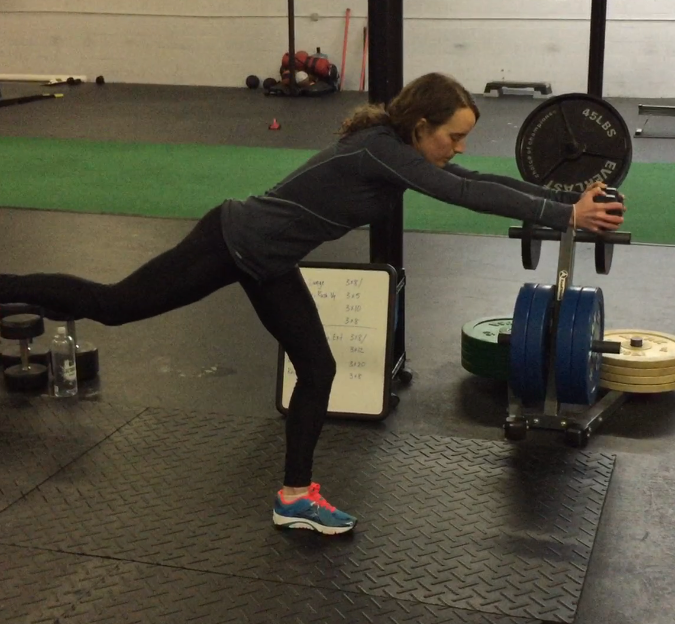
B2) Pallof press “I”(core) (3×10 reps x 3 breaths) *this involves making some kind of movement with a restiance against me, the image is not the “I” but it is another one we have used.

C1) Suspended Row (3×10 reps)
C2) Plank variation (3×10 breaths) *That is hard! Drew makes focusing on form a priority….FYI I used to be able to do a “plank” for up to 6 mins….but I was doing it wrong!*
C3) 1 Arm KettleBell Carry (3x sets of varying distance)
That’s it!
Does it look too simple?
I told you it would be underwhelming. *Although we do sled work like in the featured image some days, and that is pretty funny to watch…well, would be for you!*
You may not know what some of those exercises are or how to do them, but they are the same exercises that I might use with an average Joe who wants to get strong and drop some body fat.
THAT IS THE POINT!
Remember when I said Tina was in good shape, but she didn’t move well?
She wasn’t strong and her “training age” wasn’t anywhere close to her chronological age. My job is to bridge that gap.
Tina was accustomed to doing circuit training with light weight and high reps and I’d venture to think that most people reading this blog follow a similar “strength training” program.
There’s nothing wrong with that, but if that describes you, I think that you may be wasting time and energy following a circuit program with a dozen exercises.
If you can you should work these exercises in to your training program regularly – and when appropriate, train them with heavy weights.
I mentioned “mastering a handful of exercises” in the beginning, and here are my biggies. *he means what you should focus on doing with your body while executing the exercises*
Hinge – deadlift, RDL variations, rack pull, pull through
Squat – lunge, split squat, box squat,
Pull – Row, pull up, pull down
Press – push up, bench press variations, overhead press
Carry – loaded carries (There’s an almost infinite list here, but pick up something heavy and carry, push, or drag it.)
There are others, but as I mentioned earlier, runners tend to do too much and I always look for the lowest effective dose with training.
Each exercise in my training is picked based on the individual and their particular movement idiosyncrasies, so I may exercises differently for different people.
In summation, just because someone is “elite” in their sport, doesn’t mean they’re elite in the weight room.
Often times you can accomplish more by doing less and really hammering the fundamentals and adding some basic strength to a gifted athlete can magnify their sport skill.
I think that Tina’s recent accomplishments from London to The Army 10 Miler to a new PR in the Philly Half Marathon are a testament to this.
Granted, she has amazing desire for excellence and a great run coach, but strength is invaluable to her success and she has bought in to the system.
There is only so much of you to go around, don’t waste it.
If you have questions, contact me at wattsperformancesystems@gmail.com
Isn’t he awesome! If you have any questions for him, add them in the bottom! I am thinking about having a podcast episode with Steve and Drew together in the near future. I had a lot of requests recently for more about my training. What do you think?
What would you like to ask Drew? Is it what you expected?

31 Comments.
I love me some Drew! 🙂 LESS CAN BE MORE. THERE IS AN OFFSEASON. We’ve gotten too into the “rest is fer the weak” notion with fitness in general and strength training specifically.
You should definitely do that podcast!! This is SO helpful and reaffirming as I don’t look like I’m doing much in my strength workouts but, it’s exactly what I need to be doing. Thank you for this!!
Love this post! Very informative, and so important for runners. How about a podcast with Drew? 🙂
Read the bottom of the post 🙂 hehe you answered my question!
That was really interesting! I do a lot of those exercises but do tend to do lower weights with higher reps. I am on a quest to keep that chronological age close to the training age. I do not do any carries-going to look into that.
This is fantastic! I really like the emphasis on different movements: the pull, press, hinge, squat and carry and I also keep reading that the heavy weights are much more effective and efficient. And of course, congrats for all your hard work Tina and seeing it really pay off!
While I’m nowhere near elite, running is my main focus and I know many weightlifting coaches wouldn’t be familiar with working with someone who runs 60-75 miles a week. So, what kind of questions do I ask a potential strength coach? Even if they haven’t worked with runners before, somewhat like Drew mentioned, what should I expect them to know/say/do when interviewing them to trust that they *could* be beneficial to my running rather than trying to turn me into a gymrat? Thanks for any info!
This is a great question Hilary and people should be more particular about whom they hire for training. Find out about their training philosophy and how they assess clients / athletes. I’ve witnessed dozens of trainers who have their clients perform deadlifts, lunges, etc with AWFUL technique. There are so many fine nuances with each exercise that you want to make sure your trainer pays attention to detail. And if they don’t want to be interviewed, move on to someone else…
LEXLIFTER is Drew by the way 🙂
This is amazing and awesome. Thanks Tina and Drew for sharing this! Such a great reminder that more isn’t always better and we really do need to focus on correct movement first. And yes! That podcast would be a great resource.
This is such an interesting read. I love reading about the strength training side of running because I’ve personally found it soo helpful. I get injured far less and I’m far stronger when I run. This year I turned my strength training around from high reps low weight to low reps and high weight and it’s far far better. That said, there is a place for working on muscle endurance using a higher rep range (like 12-15 reps). Great post!
Anna,
Just a quick thought on training for endurance…I would say that your muscles are getting lots of endurance training via the actual running. If you spend all your time at the low load / high reps end of the spectrum, you should work more for strength. Conversely, if I have a football player who is huge and strong as an ox, I’m going to work on speed, footwork, and coordination to fill in the gaps and improve overall athleticism. I hope that makes sense.
Thanks for this post! I have often struggled to include the right amount of strength training into my routine. I do agree that it can make you run faster. I recently started some strength exercises using my own body weight (ie- no extra weights), and have found this to be great for me- I can already see improvements in my speed. Otherwise, if I add extra weight, I tend to get injured. I appreciate this helpful information from coach Drew– it gives us a new perspective on weights and I might have to include this into my routine. Thank you! @janerunswild.com
This is fantastic! I’m pinning this to save as a resource. I appreciate how he breaks down the moves into hinge, squat, press, pull, and carry – those provide great guidelines for making one’s own routine. You should do a podcast with Drew!
Strength training properly is something I have neglected for too long and I wasn’t aware of the benefits that come from increasing weight… Since gym membership is expensive, the ‘strength training’ I do at the moment is only with light dumbell and body weight exercises at home so if Drew has any suggestions about how to get the most out of this set-up until I can access better equipment (which will hopefully be soon!), then they would be gratefully received! Thanks 🙂
Charlotte,
Something that I didn’t include in the post is that mastering bodyweight training is critical to the foundation we build. You can make a bodyweight workout very challenging when exercises are performed with precision. My advice is to invest in a few kettlebells. One each of: 18lb, 26lb, and a 35lb. I can crush most people with this set up. You might spend $150 but the possibilities are almost endless when it comes to workouts. If you need more specific help, just email me. Good luck!
LEXLIFTER is Drew 🙂
Look at those STRONG legs Tina…LOVE IT! XOXO
This is great info. Thanks, Drew and Tina! My first love before I started running is strength training, which I credit for helping me to lose weight & maintain my loss. But I’ve been confused about what I should do as a runner, so this is good to know. My big question is when I’m in the middle of an intense training cycle, I have very little time for anything else. What should I aim for in terms of minutes/sessions of strength work a week? Tina’s routine doesn’t sound like too much, but if the sessions are an hour, it seems like more than I can probably do while training. Also, I hurt my lower back this week picking up heavy weights wrong. Can I do squats, lunges, deadlifts without weights until it gets better? Thank you!!!
Jenn,
When you’re in the middle of an intense / high volume running phase, I recommend first addressing your tissue quality (foam rolling, mobility). After that, training four or five lifts a couple days per week should be enough. Focus on big moves to get the most bang for your buck. With an injury, the rules change…use split squats, single leg hip extensions, and plank variations to get a training effect without compromising your back. Often times, the bilateral work “demands” more from the system, and that can affect the injured area. If you have more specific questions, please email me. Good luck!
Thanks so much for the information!
Great post. I’m going to start working on strength training now that my marathon is over and this is a big help!
How would you suggest finding a strength coach to work with? I’m 46 and am shooting for another sub 3:30 marathon.
Laura,
Get referrals from runners in your community and then interview the trainers. Find out their training philosophy and see how they train. Their attention to detail is CRITICAL! Good luck and if you have any specific questions, please email me.
I would love a podcast with both of them!! I’m learning about the need for strength training and rest the hard way, aka being forced into it by my body. IF ONLY I HAD LISTENED TO EVERY EXPERT EVER!!!
Great info and a podcast with Drew would be fantastic! I love that he has you lifting heavy!
This is so helpful. I am working with my physical therapist and he really wants me to focus on weight training (Drew – I am coming back from knee surgery in April. I have a running coach. We are building a slow base and are in about week 8 of it. I ran a half marathon race last weekend and getting ready for Boston in April which is the goal race.) He wants me to so low reps and high weight and has gone over everything, but I feel like I might need more guidance in the gym to make sure I am doing everything correctly. Can you recommend a strength coach in West Los Angeles? YES to a podcast!!! That would be awesome 🙂
I know of one person and I sent him an email. Hopefully I can get you guys together. Best of luck!
That is awesome!! Thanks so much Drew! 🙂
Please send me an email to wattsperformancesystems@gmail.com and I’ll send you his info via email.
Good advice but i find him a bit condescending, arrogant and prejudiced in the way he speak(it sounds like he is the only good one out there) At least he gives advice on how to do it properly for those of us who can’t afford to hire a professional or to go to the gym.